
federAted oRchestration In EV fLeets
ARIEL
Federated learning at the edge for electric-vehicle fleets: charging-demand and solar forecasts trained where the data is produced.
- Programme
- Horizon Europe · O-CEI Open Call 1
- Area
- Energy · Mobility
- Status
- Completed
- Partners
- Österreichische Post · AVL · Energie Steiermark
Overview
ARIEL (federAted oRchestration In EV fLeets) brings federated learning to the energy management of large electric-vehicle fleets. Charging stations, vehicles and photovoltaic installations generate data continuously, but moving all of it to a central cloud is costly, slow and raises privacy concerns.
In ARIEL, forecasting models are trained directly on edge devices, close to where the data is produced. Only model updates are shared, and they are protected before they leave the device. The project is funded through Open Call 1 of O-CEI (Open Cloud-EdgeIoT Platform Uptake in Large Scale Pilots), a Horizon Europe project, and is carried out in Pilot 3 together with Österreichische Post, AVL and Energie Steiermark.
How it works
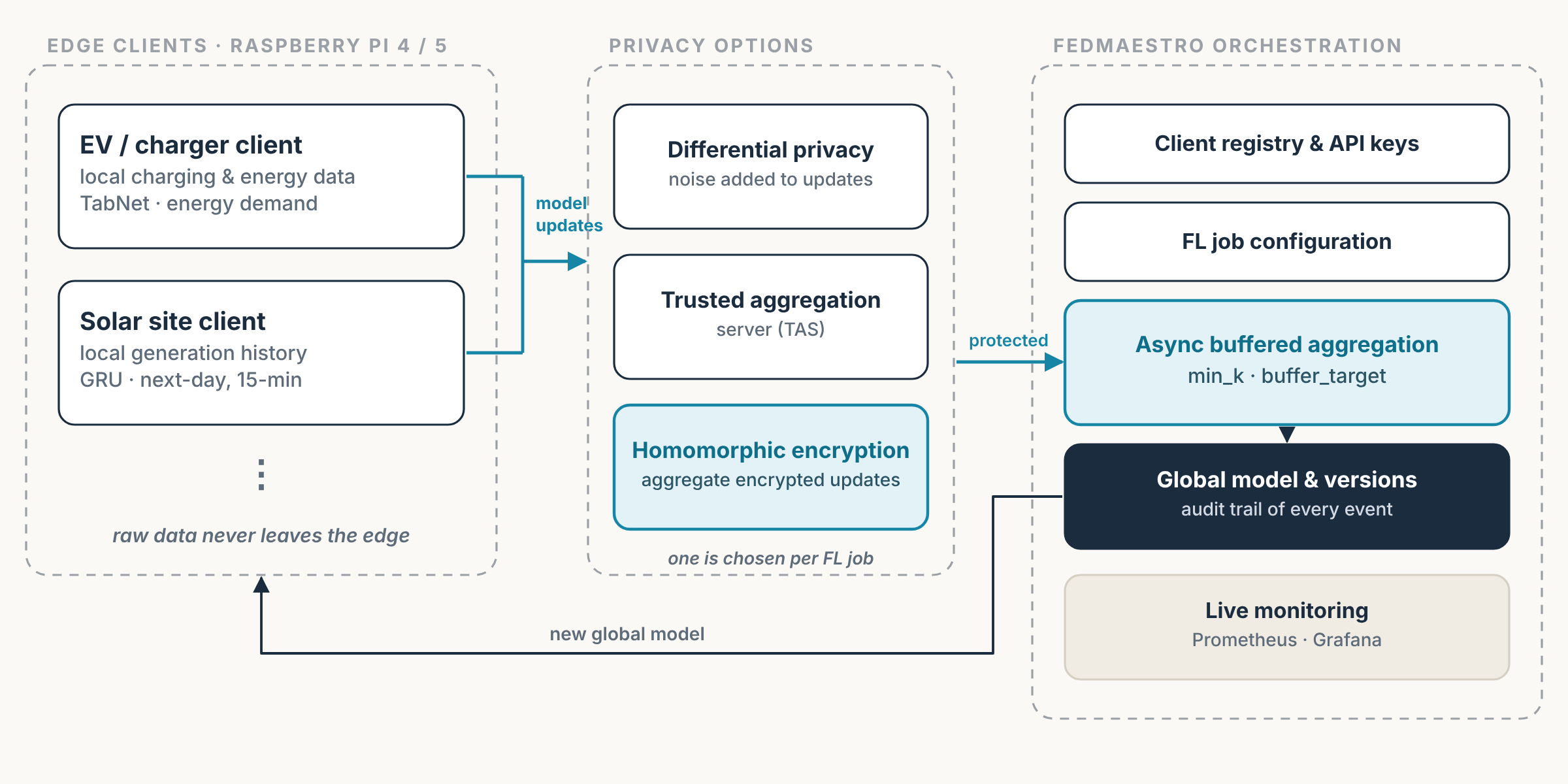
Each participant runs a lightweight client on edge hardware such as a Raspberry Pi. Clients linked to vehicles and chargers learn to predict energy demand, while clients at solar installations learn to forecast next-day generation at 15-minute resolution.
Our FedMaestro platform coordinates the training. It registers the clients, configures each training job and combines their updates into a shared model. Aggregation is asynchronous, so devices that are slower or temporarily offline do not hold up the rest. Every model version is recorded, and operators can follow the entire process from a single dashboard.
Privacy built in
Raw data never leaves the edge, but model updates can still reveal information about it. ARIEL therefore offers three ways to protect them, selected for each training job:
- Differential privacy adds calibrated noise to each update before it is sent.
- A trusted aggregation server combines updates in an isolated environment, at a time overhead of 11–15%.
- Homomorphic encryption lets the server aggregate updates it cannot read. Accuracy on EV demand drops by only 1.45%, although encrypted updates are about 22 times larger.
No single option is best in every situation. The right choice depends on the trust model, the available bandwidth and the overhead that is acceptable.
Results
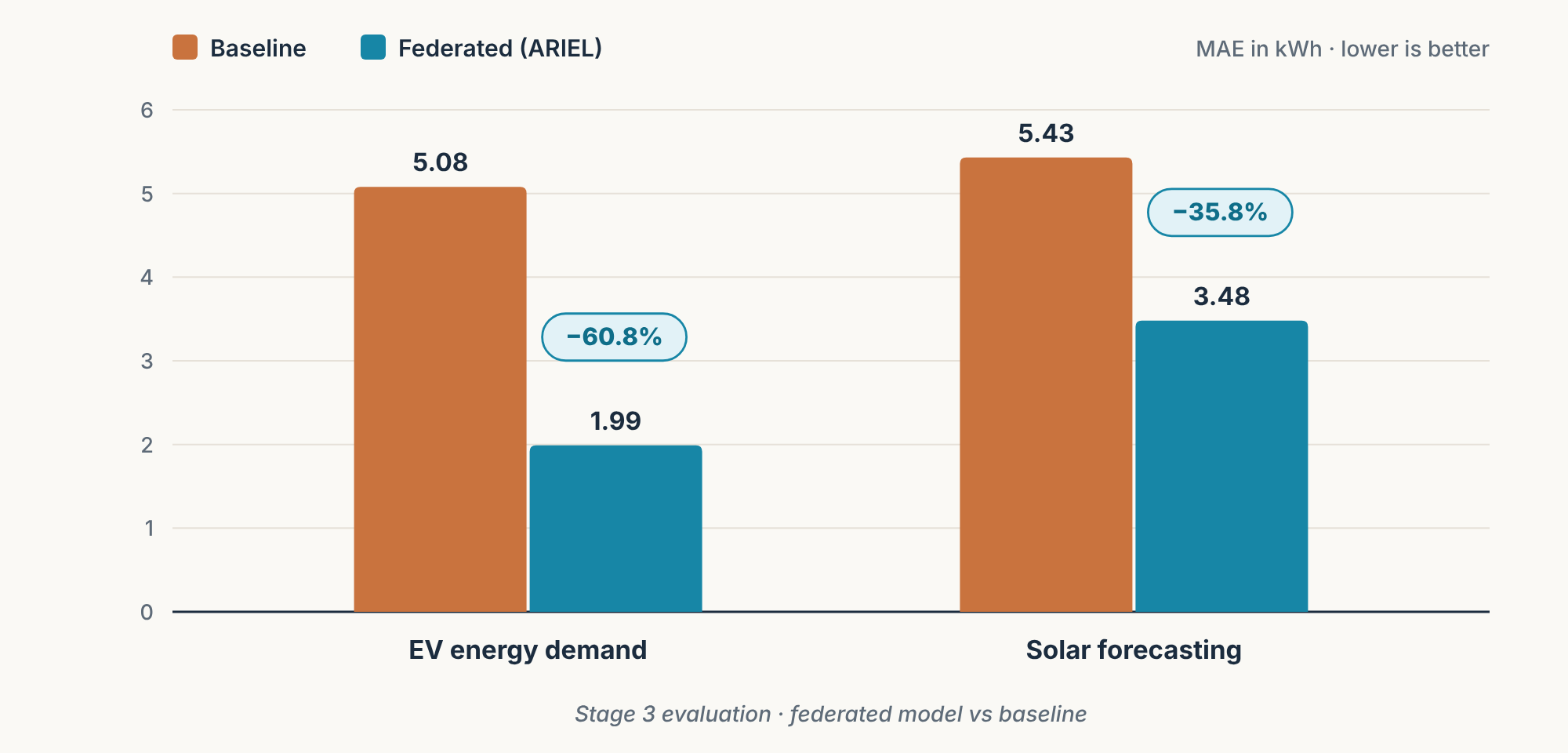
In the final testing stage, federated training clearly outperformed the baseline:
- EV energy demand: a mean absolute error (MAE) of 1.99 kWh against 5.08 kWh, a 60.8% reduction.
- Solar forecasting: an MAE of 3.48 kWh against 5.43 kWh, a 35.8% reduction.
- Coordination overhead: only 0.20–0.69% of local training time.
Over the course of the project, the solution advanced from late TRL 4 to TRL 6, demonstrated in the O-CEI Pilot 3 environment.
Key features
- Federated training of forecasting models on edge devices
- EV charging-demand and solar-generation forecasting
- Asynchronous aggregation that tolerates slow or offline devices
- A choice of differential privacy, trusted aggregation or homomorphic encryption
- Model versioning, audit trail and live monitoring
- Open-source components released under the Apache-2.0 licence
Impact
ARIEL shows that federated learning can run reliably on low-cost edge hardware in real fleet operations. Operators gain accurate forecasts for planning charging and making better use of renewable energy, without centralising sensitive data.
The project’s open-source components (FL-TAS, fl-async-buffered and, soon, tenseal-rpi-docker) are available on our GitHub, and the results have been published at IWAPS 2026 and WIMS 2026.